
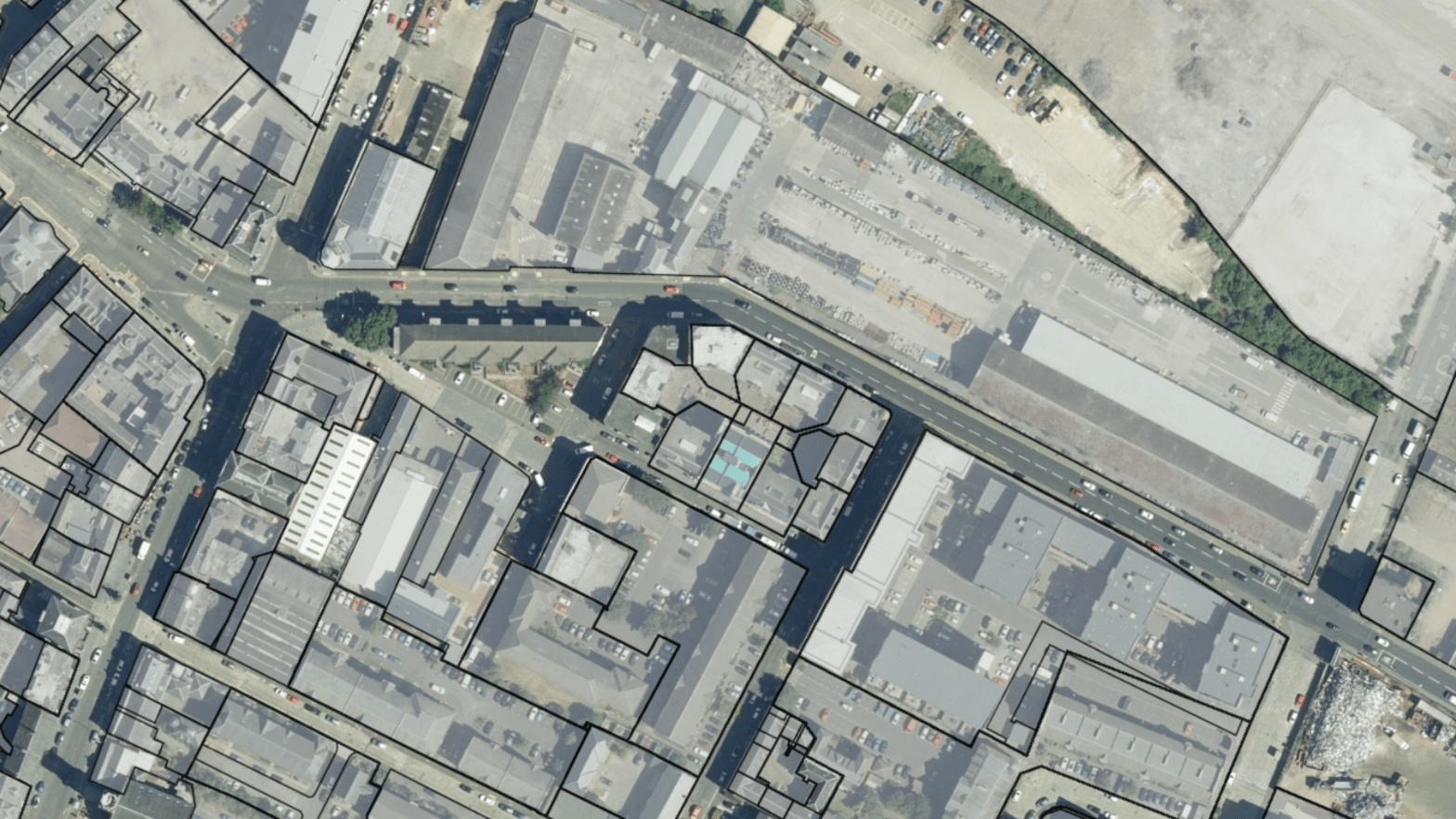
Whenever communal maintenance of any kind needs organised, how the costs get divided up can be the most contentious part of the discussion. The title deeds to a property are the first place to go and look. Since these define the property that owners buy, they can define their responsibilities to other owners too, and how any decisions and payments need sorted between themselves. The Tenements Act then sets out ways that gaps in the title deeds can be resolved by default. See Under One Roof’s article for more details.
Our tenements date from the turn of the century (approximately 1892 to 1912). The title deeds were written in a different time in Victorian/Edwardian legalese. Some of the concepts they talk about, like feu duty, have been abolished over successive rounds of land reform in Scotland. When I bought my flat, my solicitor provided me with a Notes on Title document which gives a modern summary of the title deeds and burdens.
Brief description: being the west most house on the third flat above the street together with a right in common to the solum (ground on which the property is built), the backgreen and the passage leading to the backgreen. Also with a right of access to the roof of the tenement by the common passage for the purpose of cleaning the vents.
Notes on Title for 16/8 Salamander Street, July 2018
The notes on the common repair responsibilities are:
Share of upkeep of common parts:
Obligation to pay equitable share of the expense of upholding and maintaining the roof of the tenement and all mutual walls and gables and the common passage and stair, front and doors thereof chimney stalks and the pavement in front thereof, rainwater conductors, drains, waterpipes and channels backgreen and mutual railings and poles of said backgreen and all other areas common or mutual to the tenement.
Notes on Title for 16/8 Salamander Street, July 2018
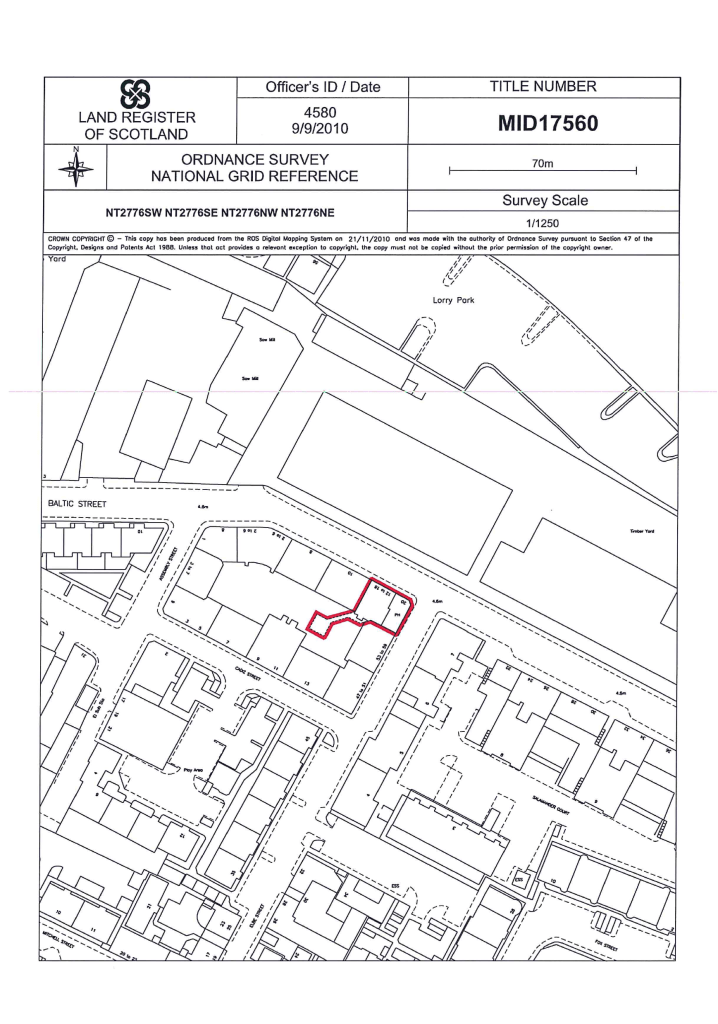
The title plan shows the land covered by the tenement.
In the original burdens, we can see that the tenement builder is directed to build certain things. Many of these are standard (e.g. gable walls which can be used to join tenements together). Some are no longer in existence:
… Further the said disponee and his foresaids shall be bound to enclose the back green and passage leading thereto with iron railings not less than four feet in height placed one half on the ground hereby disponed and the other half on the adjoining ground and when the adjoining ground comes to be feued out and built upon the said disponee and his foresaids shall be entitled to recover from the adjoining feuars one half of the value of said iron railings as the same shall be ascertained by valuation as aforesaid and the same shall thereafter be mutual between the said disponee and the adjoining feuars and their respective heirs and successors in all time coming.
Burden 1 – 16/8 Salamander Street title
These iron railings were the standard separation between different tenement back greens when they were created. Unfortunately a very large proportion of all non-safety-critical iron railings (e.g. not stair balusters) in the UK were removed in WWII as part of the war effort. According to the factoring department at Port of Leith Housing Association (who own around 1/3 of the flats and factor two of the tenements), by the 70s when the council grants happened, there were earlier dividing brick walls instead but they were in a poor state of repair.
Back green areas were a required part of any tenement at this time, so that there would be somewhere to bleach and dry clothing and linen. As an example, the special Camphill Gate tenement in the south side of Glasgow had no space for a back green at the back and so it had to install a drying green on its flat roof! This space is now used as a private roof garden terrace.
The title deeds even say in the property description:
… which backgreen shall be used exclusively for the purpose of bleaching and drying clothes …
Property description – 16/8 Salamander Street title
This will be common. In these times it wouldn’t have been implausible for much more disruptive activities to have gone on the back green instead if they had been allowed. Early Scottish tenements might have even had farm animals outside!
So all our tenements will have had a little bit of space set out as their back green. The only exception will have been 9-11 Cadiz, which was built as a warehouse rather than a residence. It was only converted into flats in the 1980s. The fact the tenements are so tightly packed together meant that some of the back green areas ended up being odd shapes. And, more interestingly, some of them weren’t even possible to divide up properly. In this ScotLIS map of the title plans, you can see that the tenements of Elbe and Assembly Streets don’t have their own unique space. Instead, they share a slightly larger back green area with their neighbours. When this happens, the title deeds will set out the communal responsibilities.

With dividing walls or railings up, the back green areas would have been small. Each one is only really large enough for a laundry pole square. From the title burdens, we can see that originally there would have been at least 4-foot (1.2m) high iron railings. These would have stopped people casually walking between the back greens but they wouldn’t block the light. I don’t know what height the replacement brick walls would have been, but in the 1970s or 80s the council came in with an improvement grant and installed the current low brick walls.
These council grant works have deliberately created a back green setup where residents can trivially walk from one back green area to another. Theoretically, owners might even be trespassing when they do that. For the council to install the wall layout was relatively straightforward: it’s just a job for a few bricklayers. Getting the titles changed on the tenements so that the back green was then properly made common between all would be much more complicated. The council grants were effectively free money and owners had very little reason to create problems. Changing the title deeds would involve a lot of bureaucracy, and for relatively little gain. It would take a considerable amount of cost and effort for owners to make use of any legal power they might have to re-erect proper dividing walls between the back greens. It’s quite possible that people were already freely walking between them just because gaps had opened up unofficially.
The consequence of this is that we (probably) have de jure responsibility and right of each tenement over only the area set out in its title plan, but de facto a complete shared responsibility and right over the entire area. It has been 40-odd years since the council installed the current layout. If it didn’t work, then it would have been changed back by now. From what I’ve seen people are happy to go along with the council plans and make use of the whole space and not just their own bit.
The fact that each and every flat has essentially equal access to the entire back green area is why I have assumed the cost of the garden maintenance would be divided equally between all the properties with any right or responsibility over any back green area. My tenement possibly has the smallest back green of any of them – should it pay less, if we’ll all just spill over into other areas anyway?
However, I know that different tenement residents have invested different amounts of time and effort into cleaning their own area. The upfront and ongoing maintenance are different questions. If you’ve kept your area clean, then paying a complete share for the overall cleanup works doesn’t seem right. However, in the long run the ongoing cost of keeping the area clear will be the same as the other areas regardless of how clean it is now. The residents I have spoken to in this position appear happy to pay the ongoing cost but not the upfront cost. That said, if they are the only residents in their tenement keeping it clean, then it doesn’t appear to stand that the other owners should get off completely free, as they didn’t do the work. But, should they then subsidise the cost to other tenements of the upfront cleaning? I don’t know. We’ll have to agree this between the owners.
Ultimately the cost of the back green works appears to be small enough that quibbling is not worth the time or effort. Getting proper legal advice over any of these issues would be much more expensive than any works we’re likely to attempt in the back green. The only advice I’d be personally tempted to get is whether the de facto commonality of the back green will ever become de jure by default given the long length of time it has been in place. My understanding is that public rights of way can become hard to extinguish, even on private land, after they’ve been used for a long time, so it might not be totally unprecedented.
However, just because something is in the back green doesn’t and shouldn’t mean it becomes common to everyone. It is not unreasonable for every property to pay its share of standard weeding costs, since they affect the desirability of the entire space. However, if there are specific problems affecting one tenement on its own (e.g. if the vegetation has grown enough to damage the stonework or drainage system) then the costs of remedying that damage would be up to the owners in that tenement.
Equally if there are issues with the secure entry system or back door, this should be dealt with by the owners in that tenement even though any problems they cause could spill over into the back green. If the secure entry system to the close doesn’t work, then it may allow antisocial behaviour to spill from the street and into the back green again and undo the work we do to make it a nicer place.
Unless we rewrite the title deeds (at high cost and difficulty) to create communal responsibilities across the back green and accesses to it, we will just have to face problems like this the best we can. The majority of owners in each tenement seem to be keen to fix any issues, using the powers available to them under the Tenements Act. By establishing trust between owners that we are doing sensible things to minimise costs and maximise benefits to everyone, we should be able to get things done even if there are gaps in the legal responsibilities.
 SECAB
SECAB 