
This post is an update on how the quotes are stacking up for the back green professional maintenance.
In my communications with other residents and owners I’ve said it would be less than £5 or £10 upfront and £5 or £10 per flat per year afterwards. This was based on the original quote I received from JDS Gardening on the 11th of May. I was always aware that we would have to agree quotes between owners before starting work. However, getting one quote first gave me the approximate figure which I could then use to encourage owners to get in touch. Had this approximate figure not been available, I don’t expect I would have been as successful.
The details of this quote are:
Gardening:
- Clearing all weeds and moss off hard surfaces
- Trimming of any shrubs
- Removal of all green waste
Upfront cost: £795.00 inc VAT
Regular garden upkeep – Maintenance of the area:
- 4 visits per year
- Spraying the site with 8-month residual herbicide to prevent weeds growing on hard surfaces
- Spraying the hard surfaces twice a year with a biocide
- Trimming shrubs twice per year
- Disposal of all green waste
Monthly cost: £52.00 inc VAT paid by Direct Debit
Divided equally between the ~170 properties responsible for the back green, that comes to £795/170 = £4.68 upfront and a £52*12/170 = £3.68 per year, per property.
The second quote is from Spruce Garden Services and is for:
For a once off clean up of courtyard which includes treating all weeds with herbicides and a follow up visit to strim to paving level and remove waste.
Upfront cost: £960.00 inc VAT
For a fortnightly visit to cover the following:
- The treatment of weeds
- The clearance of dead weeds to paving level
- Blowing off and removal of leaf litter
- Fortnightly through summer (16 visits)
- Once a month thereafter (5 visits)
Cost per visit: £180.00 inc VAT
Divided equally between the ~170 properties responsible for the back green, that comes to £960/170 = £5.65 upfront and £180*(16+5)/170 = £22.24 per year, per property.
These are quotes which give us an indicative idea of how much the back green would cost each owner. However, as with any quote from a professional, they won’t be set in stone. It is possible that the weeds prove more difficult to remove than the professionals expected, in which case we may need to pay up more. Also, other residents have recently gone and done some clean up works on some part of the back green, meaning there may not be as much work to do now as was quoted for.
It will be up to the other owners to decide what we do if costs increase. While the cost per property is fairly small, I do know that some owners will want to minimise any unnecessary expenditure right now.
I will be getting more quotes, and asking for updated quotes given the strimming work that other residents have done. I do not expect these to dramatically change the figures; the ongoing cost will end up being the same but it might save a bit on the upfront.
The strimming works done by other residents have reduced the amount of vegetation visible from a distance but the weed roots are still there. To get rid of the weeds we will need to make sure the root systems are properly killed off. This is what the professional gardening companies should be able to do quite easily.
Gardening qualifies as maintenance under the Tenements Act. It may sound quite different to normal maintenance worries like leaking roofs. The Tenements Act does cover other aesthetic/cleanliness tasks too, like painting the stairwell. Gardening issues will start off that way too, but they can also end up causing real maintenance problems.
When you look at most tenements, you can see vegetation where it really shouldn’t be. Plants grow wherever there are nutrients, natural light and water. In most tenements that means they end up growing in the gutter and sewerage systems.
Clearing plant growth out of the gutters is vital to keep the gutters functioning. We can expect increasingly heavy rain with the climate emergency, so any plant mass blockages will cause a big problem. If the water builds up in the gutters they will eventually fail, at major expense to the owners. This is easy enough to resolve by getting a roof access worker or cherry picker to clear them out every once in a while. I hope that we can organise this across the tenements to save us all money – once they’re kitted up to do one tenement, doing the one next door, and then the one after that, won’t take them very long.
When plants grow in the sewerage system, it won’t be as clear that it is a real building maintenance issue. It’ll just look like the garden hasn’t been looked after properly. However, over time, roots grow into every possible nook and cranny. They will get harder and harder to remove. As the roots get thicker, they can eventually cause iron and terracotta drainage parts to crack and leak water. This then causes even worse problems as foul water can seep into the building, saturating the sandstone and causing damp and smell problems.
Therefore over time, ignoring a plant that could easily be pulled out by any resident could end up causing thousands of pounds’ worth of damage to the structure of the building. It is therefore very sensible to spend a tiny sum of money upfront and keep these problems well at bay.
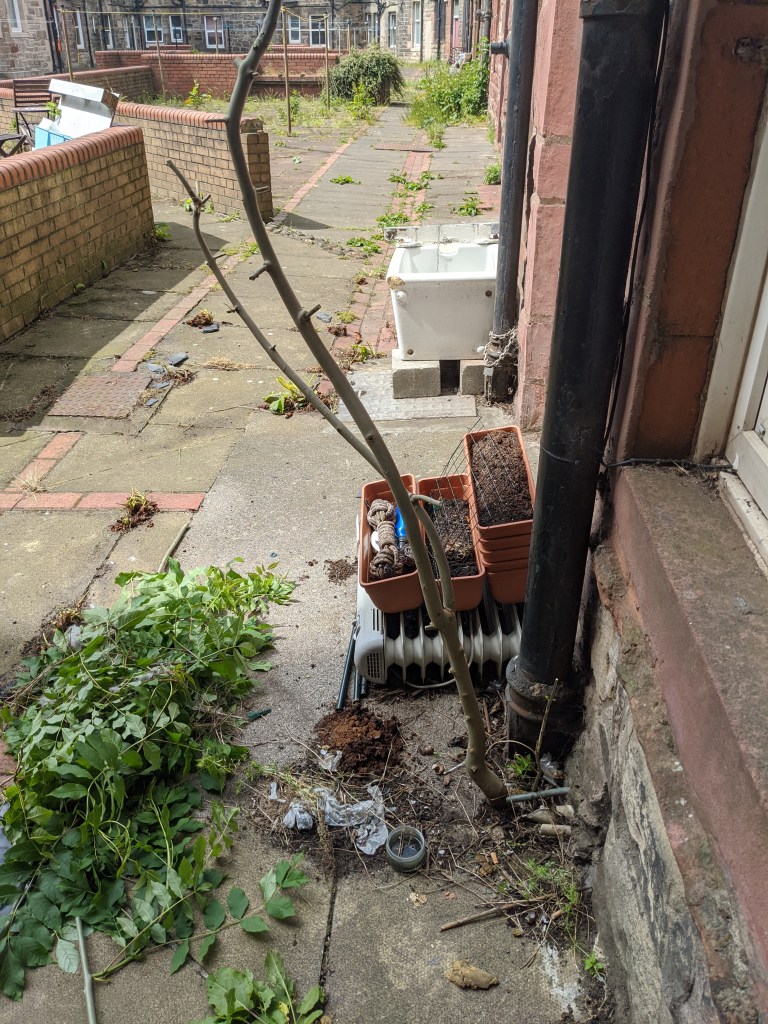
Some residents have discussed with me their concerns about using non-natural weed killing chemicals in the back green. I am not a gardening nor environmental expert. I know that other long-established residents have found salt water to be an effective weed killer. If we decide that another weed killer should be used instead, then I am sure we can find someone to apply it.
I expect we will also want to look at quotes to get some of the brick seats and planters fixed. This should be a fairly simple job for a bricklayer. Most of the bricks are fine but some have been broken off by time or vandalism. The ‘special’ capping bricks are still standard (double bullnose) and were common on projects around the late 70s and early 80s when the current back green layout was created.
The laundry poles will also need painted, but this could be an afternoon’s work by a resident. A tin of Hammerite doesn’t cost very much. Each tenement has its own laundry pole square.
We may well find that some residents are willing to take on small maintenance jobs if they need a bit of cash and they have the time to spare. If anyone has or knows someone with useful skills (bricklaying, painting, gardening etc) then get in touch.
 SECAB
SECAB 